





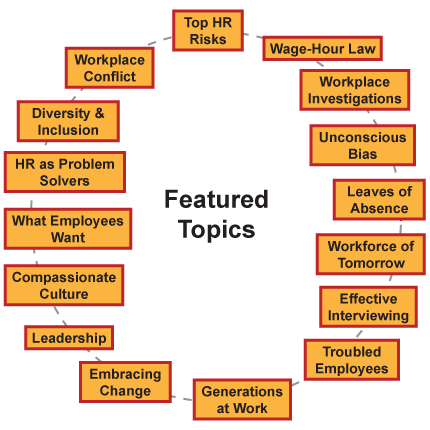
There will be 17 different sessions in total.
(Print this page out for easy reading and reference.)

Keynote Address:
From Prominence to Prison: Dealing With Moral and Ethical Dilemmas in the Workplace
Patrick J. Kuhse
President, Speaking of Ethics

Back by popular demand and overflowing with new insights, Patrick Kuhse will share several key lessons, warning signs and critical thinking errors that often lead to grave outcomes both in the workplace and in life. With masterful storytelling ability, Patrick will show how a series of seemingly unimportant decisions ultimately can prove to be the difference between personal integrity and eventual fraudulence. In this entertaining, illustrative and informative keynote presentation, Patrick will take you on his own personal journey - from a successful stockbroker with a loving family in San Diego to the jungles of Central America as an international fugitive to incarceration in two countries. Along the way, Mr. Kuhse will detail various measurements to use as an "early detection system" to determine when employee behavior is not in alignment with established ethical and organizational standards. In human resources, raising personal awareness of subtle and covert wrongdoing is essential for the prevention of deceit and the erosion of values. After all, each of us is faced with moral and ethical dilemmas in life; Mr. Kuhse will illustrate the preventive techniques and lessons learned to develop practical, constructive and effective strategies for lasting success.


The Family and Medical Leave Act: Top Ten Employer Mistakes
Mark S. Floyd, Esq.
Partner, Thompson Hine LLP

The Family and Medical Leave Act is a law that is still evolving. You are not alone if you consider the FMLA as a potential trap to make mistakes as it is often violated inadvertently by employers. This presentation will provide updated information about what employers really need to know in 2008 to make sure that they are in compliance with the most recent court decisions under the Family and Medical Leave Act. Going beyond the basics of FMLA, this session will focus on the top ten mistakes that employers make when applying FMLA in the workplace. Mark Floyd will lead a lively discussion focusing on the examples and the hypotheticals that will help to explain FMLA in practical terms. In light of the significant damages that have been awarded recently in FMLA cases, this statute merits even more attention now than ever from both HR professionals and their counsel.


Conducting an Effective HR Audit
Annette A. Idalski, Esq.
Partner, Duane Morris LLP

Whether or not employers want to acknowledge it, these days all companies are at risk for employment-related lawsuits. Given the high cost of defending a suit, dealing with the potential negative publicity, as well as the considerable time spent in litigation, strategic preventative measures should be taken to stay out of harm's litigious way. Human resources professionals can significantly limit the exposure to an employment-related lawsuit by completing a thorough HR audit. Such an audit should include an in-depth review of the company's employment policies and procedures from the initial interview all the way through to termination. This session will outline a comprehensive procedure for conducting such an HR audit. By attending, you will learn how an effective HR audit:
• Ensures compliance with wage-and-hour laws and other employment and benefits-related statutes.
• Examines the effectiveness and costs of HR policies and practices and their role in the organization's strategic planning.
• Reduces expenses by identifying and correcting inefficiencies and compliance problems.


FLSA: Implementing Practices to Stay Ahead of the Fair Labor Standards Act Curve
David Long-Daniels, Esq.
Shareholder, Greenberg Traurig LLP

According to the U.S. Department of Labor, about 115 million employees, or 86 percent of the workforce, are covered by federal overtime rules set forth by the Fair Labor Standards Act (FLSA). Yet, the U.S. Department of Labor estimates that nearly 70 percent of employers are out of compliance with FLSA laws. Stay ahead of the curve and minimize liability by learning how to avoid the common pitfalls and unforeseen consequences of not being compliant with FLSA laws. This engaging session will dig deeper into FLSA nuances and provide practical steps enabling you to:
• Understand what the FLSA laws require of your company.
• Properly classify exempt and non-exempt employees.
• Know how to treat additional benefits for non-exempt employees.
• Identify and correct any unlawful pay practices.
• Establish procedures for reporting suspected wage violations or pay problems.
• Ensure that your company has the proper procedures in place that will remedy or limit liability in the event of legal action by employees.


Becoming More Emotionally Intelligent
Nancy Allen
President, Impact Training & Development

Emotional Intelligence (EQ) is a way of recognizing, understanding and choosing how we think, feel, and act. It shapes our interactions with others and our understanding of ourselves. In addition, EQ defines how and what we learn, it allows us to set priorities, and it determines the majority of our daily actions. Research suggests that emotional intelligence may be responsible for as much as 80% of the success in our lives. Further, emotional intelligence helps to explain why despite equal intellectual capacity, training and experience, some people excel while others of the same caliber lag behind. Fortunately - unlike IQ - emotional intelligence can be enhanced and even improved over time. After a brief introduction, this presentation will delve into how to become more emotionally intelligent. Along the way, the session will address:
• The core EQ competencies.
• The feelings that drive behavior.
• Triggers that can cause “hijacking”.
• Self-management and self-awareness.
• Managing emotions to build the kinds of relationships that get results.


The Emerging Role of the HR Business Partner
Valerie Frederickson
CEO, Valerie Frederickson & Company

According to a recent Deloitte Consulting survey, despite rising demands from the executive suite for the HR function to support overall business objectives, the transformation of human resources, particularly at large global companies, is still largely about savings, systems and processes. But that landscape is changing dramatically for organizations and their HR professionals. At forward-thinking, market-driven companies, HR’s contribution is increasingly being measured by how well HR supports the company’s business objectives and addresses the strategic people issues – and not by administrative efficiencies and cost-controlling capabilities. At these progressive organizations, a new role is rapidly emerging to build the alignment between human resources and business operations: the HR business partner. This seminar will examine the emerging role of HR business partner and its future role in the organization. Topics discussed will include:
• The background and experience needed to succeed in this position.
• How to meet expectations from both the executive suite and HR.
• Roles and responsibilities: are you a trouble-shooter, a trusted consultant, or a jack-of-all-trades.
• The consulting processes that should be part of your tool kit.
• Coaching and resources to augment your skills.


Good Health is Good Business: How to Launch, Manage and Measure a Successful Health Enhancement Program
Dr. David Rearick
Vice President of Medical Management, Strategic Benefit Solutions, Inc.

Stephen Cherniak
Wellness Director, Strategic Benefit Solutions, Inc.

By improving employee health and productivity, human resources is becoming a major contributor to profits, share price, and the competitiveness of successful organizations by managing every organization's most valuable asset: the investment in human capital. This session will guide you on what to do - and more importantly - what not to do when building a culture of health and wellness at your organization. With the launch of several wellness initiatives under their belts, the speakers will celebrate their successes and share their insights. As part of this informative and entertaining session, you will learn:
• How to achieve buy-in from the C-suite.
• How to sell the value of the program.
• What milestones should be measured.
• Which steps are required in order to be successful.
As you will learn from this presentation, good health is definitely good business.


2008 Trends in Employment Law: Being Prepared
Clare H. Draper IV, Esq.
Partner, Alston & Bird LLP

Responding quickly and effectively to a wide range of workplace issues is the hallmark of the HR professional. Being prepared for the new and unexpected is critical to HR success. We saw numerous changes in the employment law arena in 2007, and in 2008 many of those changes have sparked trends in litigation and compliance issues for which employers need to prepare. In this session, we will explore emerging trends in areas such as wage and hour litigation, caregiver discrimination, retaliation claims, WARN class actions and FMLA leave. We will discuss both the key sources of risk and liability and some strategies designed to meet business needs, to manage risk and, of course, to avoid litigation.


Interactive Recruitment Marketing: Effectively Navigating the Internet to Attract A-Level Talent
Tina Davis
Executive Director, NAS Recruitment Communications

Navigating the world of online recruitment is an ever-changing - and often complicated - endeavor. Gone are the days when everyone looking for a job went straight to the newspaper classifieds. The Internet has caused the process to become more fragmented, and organizations must now go beyond traditional mediums to ensure that they will reach and attract the right talent. This means that they must use the Internet but with products and services popping up every day, it is often hard to know where to turn. This program will illustrate just how complicated online recruiting has become while showing how it is possible to cut through the clutter and develop the most effective online strategy. Attendees will leave with new ideas that can impact their organizations immediately. Key take aways include:
• A clear picture of the current online recruiting landscape.
• A thorough understanding of interactive strategy development from website design and execution to online recruitment advertising.
• A sneak peak into the next generation of online products.


Conflict Management for HR Professionals
Dethra U. Giles, MBA, MSCM
Director of Staff Recruitment and Retention, Georgia State University

Human resources professionals are often skilled at understanding and calculating the hidden costs of important employment-related issues like turnover, but there is an equally important hidden cost that HR professionals frequently overlook - the cost of internal conflict. Poorly managed workplace conflict manifests itself in complaints, grievance filings, reduced productivity, lawsuits, and even workplace violence. When internal conflict is left unaddressed and unmanaged, companies risk losing unity, efficiency, and potentially millions of dollars in expenses and lost revenue. And when something does go wrong, who does the organization turn to for an immediate fix? You guessed it: human resources. This interactive session will help HR professionals first define and then better understand the complex dynamics of workplace conflict. In particular, the session will provide attendees with:
• The three main types of workplace conflict.
• Practical tips for managing workplace conflict.
• Hands-on opportunities to use the tools provided to handle conflict.
• A “trial run” at managing workplace conflict with a helpful case study.


The I-9 on Steroids: Immigration Law Strategies for the New Electronic Enforcement Era
Charles H. Kuck, Esq.
Managing Partner, Kuck Casablanca & Odom, LLC

Every month we hear more news about the massive changes to the I-9 procedures – from Homeland Security's new "no-match" rules to unprecedented state laws to compel employers to electronically verify work eligibility. Yet despite these changes, compliance in the new era of I-9s is neither straightforward nor effortless. This session will offer practical guidance on how to get started, including the importance of putting the human, procedural and technological systems in place. Along the way, Chuck Kuck, noted immigration attorney and National President-elect of the American Immigration Lawyers Association will discuss the new rules and challenges of using the E-Verify system, including:
• The high "false-positive" rate and conflicting state laws.
• The top ten I-9 compliance mistakes.
• How best to train people company-wide on the new I-9 rules.
• Who should administer and oversee the new I-9 process.
• Why the AFL-CIO filed suit against the DHS proposed rules.
• What government actions are likely to occur in the near future.
In addition, the session will provide an overview of various electronic system options, as well as the advantages of employing an electronic system for more precise compliance, reduced workload, and improved reporting capabilities. Finally, Chuck will offer several tips for electronic I-9 management.


HR Career Success: How to Sell Your Ideas
James R. Dawson
Managing Partner, ADI Performance

Although our job titles may not indicate it, in one way or another, we are all in the business of sales. In order to succeed in human resources, we must know how to sell our ideas, our solutions, our approaches and our strategies to the other people in our organization. When it comes to making major changes to improve the workplace, the ability to sell becomes even more pronounced. Although certain individuals may have excellent ideas, if they are not able to persuade others, build consensus and eventually obtain agreement from decision-makers, their ideas will never become implemented. By attending this presentation, you will position yourself for success by learning how to:
• Identify viable opportunities.
• Understand why people buy into an idea.
• Pose the right questions.
• Build excitement for your ideas.
• Prepare for and respond to decision-maker objections.
• Ask for a commitment.


Succession Planning
Debbie McGrath
CEO, HR.com

This session will explore some of the more innovative ways as well as the true and proven methods to handle succession planning of your executive team. In addition, you will be able to interactively share market research based on a recent survey of HR Executives on their best practices on succession planning. Topics will include:
• Building a talent pool.
• Handling HIPOS.
• Avoiding the potential traps.
• Integrating the latest technology.


Identity Theft: Understanding the Impact and Taking Action in the Workplace
Robert Levy
Senior Vice President, Group Security and Identity Theft Risk Management Specialist, Pre-Paid Legal Services, Inc.

How does identity theft impact a business, its employees and its clients? There are five common types of identity theft, and each has an adverse effect on the workplace – not to mention additional work for the human resources department. When an employee becomes a victim, both work performance and attendance usually suffer. Luckily, help is on the way. New legislation will impact employers and employees alike, and the Federal Trade Commission (FTC) is strongly advising companies to understand their new responsibilities. In particular, they stress four major compliance areas that businesses need to implement. By attending this informative session, you will:
• Learn about the steps a business should take to mitigate exposure.
• Learn about FTC expectations and new legislation directly impacting companies.
• Receive tips and valuable information pertaining to Non Public Information (NPI).
• Leave with resource sheets on identity theft and the FTC.


Credit Score Enhancement and Hiring: What’s in Your Number?
Andrew Huber
Development Officer, Georgia's Own Credit Union

Human Resource professionals have many factors to consider when hiring new employees. One increasingly widespread practice in the past two years has been to consider credit reports. When consumers apply for credit – whether for a credit card, a car loan, or a mortgage – lenders need to know the level of risk they are taking on in lending the money. FICOฎ scores were created to help lenders determine that risk. Similarly, this measure has been adopted recently as a consideration in the hiring process, too. As a consequence, it is increasingly important for HR professionals to understand personal credit reports and credit scores. Everyone has three FICO scores, one for each of the three credit bureaus: Experian, TransUnion, and Equifax. Each score is based on information that the credit bureaus obtain and keep on file. As this information changes, credit scores tend to change as well. Depending on a particular score, both credit limits and interest rates can be increased or decreased, potentially saving or costing thousands of dollars during the life of a loan. This seminar will explore what a good credit score is, how the score is determined, why it is important to have good credit, and some essential tips for acquiring and maintaining good credit. For instance, did you know that missing just one payment, regardless of the amount, can take up to 24 months to restore? In addition, this session will address some of the misconceptions concerning credit scores, such as the impact of the length of employment.


Plus these others . . .

Recruiting Gen X & Gen Y: How to Succeed Where Other Companies Fail
Robert J. McGovern
Chairman and CEO, JobFox


What’s Hot in Training: Trends, Tools and Tips for Successful Employee Development
Craig Southern
Training Program Manager, Governor’s Office of Planning & Budget (OPB)