






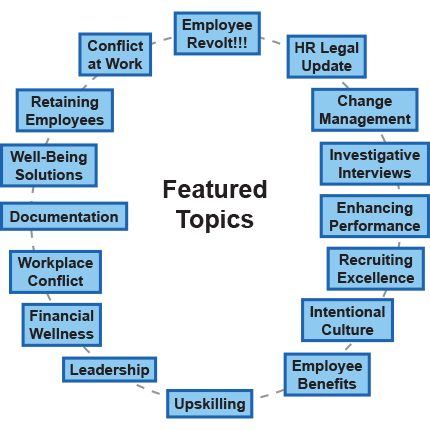
There will be 17 sessions in total.
(Print this page out for easy reading and reference.)

Keynote Address:
The Road to Recovery: HR Strategies for an Engaged Workforce
Bob Nelson, Ph.D.
International Best-Selling Author, Researcher & Innovator

As California organizations are looking to rebuild their business in the wake of the recent recession, a key element of that success is the motivation of their employees. The typical employee feels overworked and underappreciated, more stressed and less valued than ever before. Employees have been asked to do more with less and to do it faster. As a result, some 54% of employees have indicated that they plan to find a new place to work as soon as the economy improves. Bob Nelson, Ph.D., the best-selling author of 1001 Ways to Reward Employees and Keeping Up in a Down Economy, will expand your thinking for how best to leverage the potential of your employees - even with little time, resources or budget. This session will focus on researched-based elements that most inspire employees to go above and beyond to help their organization be successful in challenging times. Dr. Nelson will draw upon his own primary research as well as decades of practical experience in working with hundreds of organizations to show how the best companies take a focused and long-term strategic view of their human resources that systematically integrates key principles into the daily work practices of its managers, challenging them to identify and act on opportunities in timely and specific ways. This keynote session will cover the six dimensions that any organization can implement to create a more motivating work environment for their employees in the new economic reality. This session will be filled with specific real-life examples and techniques that can be immediately applied back on the job to systematically leverage, build and sustain a culture of engagement.


What Goes Down Must Come Up: How HR Should Prepare for the Upswing
Maria C. Rodriguez, Esq.
Partner, Winston & Strawn LLP

Organizations that are poised to succeed from a management and human resources perspective will thrive in the new economic reality. Is your company poised to take full advantage of the upswing? People who are still focusing on the downswing and not looking ahead and planning for the upswing will be left behind. This is a critical and advantageous time to tighten up management and human resources practices, evaluate and further improve talent, take care of audits, and address liabilities in the most advantageous ways. This program will:
• Provide a brief status of the current legal and business climate from a management and human resources perspective.
• Discuss and analyze hiring and management practices and how tightening these practices will help your company maximize its talent potential and avoid costly litigation in the future.
• Address the importance of talent management and how to make talent management decisions in ways that create more opportunity for growth and reduce or avoid liability.
• Discuss the value of auditing human resource, payroll and benefits policies and practices at this particular time.
• Encourage you to create a strategic plan to address any potential liabilities and that takes full advantage of the current business and legal climate.


Conducting Effective Workplace Investigations
Jane Kow, Esq.
Founder, Jane Kow & Associates

This session is designed to provide human resources professionals with practical guidelines on how to effectively conduct an investigation into a complaint of discrimination or harassment to minimize the risk of litigation and prevent liability. In particular, this program reviews the company’s legal obligation to conduct a prompt, thorough and objective investigation in response to workplace complaints as well as the critical importance of the investigator’s role as a neutral fact finder. By attending, participants will learn/review:
• How to set clear objectives at the outset of the investigation.
• How to overcome common mistakes and roadblocks in the investigation.
• How to effectively interview the complainant, the alleged harasser as well as third parties with knowledge of the underlying facts.
• How to ask questions that will overcome witness resistance and put them at ease while obtaining essential information.
• What should be transcribed in the investigator’s notes during the investigation to facilitate preparation of the summary report.
• How to organize the information gathered, analyze the key factual findings and assess witnesses’ credibility in an objective manner to reach a conclusion on the merits of the complaint.


Beyond Meal and Rest Periods: Latest Trends in Wage & Hour Law
Laura R. Petroff, Esq.
Managing Partner, Winston & Strawn LLP

The "Wage and Hour Wave" remains a threat to employers in California and nationwide. The claims are continuing to come from private, class action plaintiffs, and now there is increased scrutiny from the Department of Labor and other governmental agencies. While misclassification cases are still thriving, the latest trends are in other areas of wage and hour missteps by employers, including off the clock work, meal and rest breaks, tip pooling, and expense reimbursements. In this session, you will hear the very latest developments, including what impact the most recent Court decisions have had on how and what we pay our employees, what time employees should be compensated for, and which job classifications have been defined or re-defined by these important Court decisions. Learn the best strategies for avoiding the very expensive mistakes employers are making every day with almost every non-exempt employee. By attending, you will be better prepared to save your company significant amounts of money simply by gaining a more complete understanding of this very complicated area of our practice.


Practical Techniques and Strategies for Defusing Conflict in the Workplace
Christine Farrell
Principal, Work Matters

Unresolved workplace conflict hinders productivity, adversely impacts morale and often leads to expensive litigation. Early dispute resolution is critical to litigation avoidance, and it should be considered a key responsibility for all HR professionals. Effective facilitation techniques can successfully defuse conflicts before they escalate into formal complaints or lawsuits. In this session, attendees will learn practical tips for successfully addressing the complex and difficult matters that HR professionals often face. Using real world examples, discussion will focus how to employ certain listening and questioning techniques and time-tested strategies to discern underlying issues and concerns. These include asking open-ended questions, identifying needs, eliciting viewpoints, building credibility, finding common ground, maintaining a neutral presence, acknowledging feelings and reframing statements. You will also learn ways to frame and explore issues in a productive manner while creating a safe environment for discussion. Finally, this session will offer ideas for how to assist upper-management in promoting positive employee relations.


Talent Management: Rebuilding Morale & Revitalizing Workforces for the Recovery
Valerie Frederickson
CEO, Valerie Frederickson and Company

Recent studies are indicating that organizations are not as prepared as they should be for the after-shocks of the recession as well as the longer-term effects of cost-cutting measures. Specifically, 45% of employees are not clear on what their manager wants them to be doing. More alarming is the fact that twice as many ‘high potentials’ are quietly looking for new employment right now. At the same time, both training and development and pay for performance have been reduced or even shelved at many organizations. Burnt-out managers simply do not have the time for extended coaching or communications sessions. So what can you do in your HR role to rebuild morale and productivity in your organization? How can you quickly assess your organization’s needs for direction, change management or enhanced communications? How can you better support your leaders in revitalizing the workforce while keeping the focus on growth? How can you help prevent an exodus when hiring picks up by keeping your finger on the pulse of the staff morale? This session will address these questions with an overview of the major talent management issues facing organizations today. Included will be a step-by-step plan for diagnosing what is at risk in your organization as well as models for how to shift your organization from survivor mode to market leader - all while creating a more engaged workforce.


The Bully and the Bottom-Line
Allison West, Esq., SPHR
Managing Principal, Employment Practices Specialists LLC

When managers attempt to motivate employees through yelling, abusive behavior, aggression and intimidation, they adversely impact morale, retention and productivity. But when bullies are also viewed as outstanding performers, upper management often simply looks the other way, dismissing the behavior as innocuous. While bullying per se is not unlawful in a strict legal sense, bullying not only causes emotional wreckage, but it also brings risk and exposure to the organization. This information-packed session will explore how bullying behavior affects the bottom-line and creates potential legal claims. Using case studies and real-life examples, attendees will learn practical tips and tools for handling bullies and creating a safer workplace. By the conclusion of this unique and important presentation, attendees will:
• Have a working definition of bullying and see how it undermines productivity.
• Understand the characteristics and motivations of a workplace bully.
• Recognize the effects of bullying on co-workers and culture.
• Understand the costs and legal issues surrounding bullying.


When California and Federal Leave Laws Collide
Leonora "Lenny" Schloss, Esq.
Partner, Sedgwick Detert Moran & Arnold LLP

Managing the absence of an employee who requires time off because of a medical condition can be a significant challenge to supervisors and human resources professionals alike. The challenge is not simply finding creative solutions to get the work done during the employee's absence. Rather, the challenge also lies in sorting through and making sense of the overlapping employee rights and employer obligations created by the explosion of state and federal laws that regulate and protect medical absences. State and federal medical leave laws were enacted at different times, for different purposes, and contain varying employer obligations. Is it any wonder that compliance with these complex and unforgiving laws is not simple? Of course, the recent amendments to the FMLA make compliance an even more daunting task. Are you and your organization up to date on the latest medical leaves? An out-of-date approach to leaves may be costly. This advanced session will provide tried and true approaches to some of the most challenging leave conflicts due to differing state and federal laws that are guaranteed to simplify and streamline your next employee request for a leave.


Benefits 911: What to Do When Medical Insurance Renewals Increase by 20%
Ryan Fridborg, MAOD, SPHR
Executive Vice President, Bolton & Company

Leslie Pearce, PHR
Vice President, Bolton & Company

It is no secret that the backbone of any organization is its employees, and benefits programs are an essential way for employers to attract and retain a quality workforce. However, there are a variety of challenges facing employee benefits and human resources professionals today. At a time when organizations are facing decreasing revenues, their insurance premiums are sky-rocketing. At the other end of the spectrum, stretched employees are demanding broader benefits. In the middle, employers are left wondering what to do as they face a lack of premium stability and out-of-control cost management. Now is the time for a reality check. With some fresh thinking and a disciplined approach, employers are still able to provide a quality benefits program that is cost-effective and meets the needs of their workforce. This session will explore how to achieve this very difficult balancing act within the ever-changing benefits market. Specific areas of discussion will include:
• A look at the current trends in consumer behavior and consumerism.
• Results-oriented strategies to develop wiser health care consumers within your organization.
• Becoming both creative and strategic in providing health insurance benefits to your workforce.
• How best to work with your broker to establish a budget.
• Developing a contribution strategy that will provide cost predictability while also serving as a safety net against unexpected increases in the future.


Speaking to the Top of the House: How to Capture the Attention of C-Suite Executives and Influence Them
Diane Hertel
Principal Consultant, Right Management

The ability to capture, sustain and influence the imagination of an executive audience is a critical skill required of today's human resources professionals in organizations both large and small. Unfortunately, many managers and HR leaders on the rise do not know how to effectively grab the attention of senior-level audiences and persuade them to take action on even the most promising of ideas. This interactive session will equip you with the skills to overcome this hurdle so that your ideas are both considered fairly and taken seriously within your organization. Several key learning objectives will be explored throughout the session. By the end, you will know how to:
• Be perceived as credible, authentic, prepared and relevant.
• Understand how to immediately capture the attention of C-suite executives and forge a memorable connection with them.
• Communicate in ways that inspire a senior-level audience to immediately move your recommendations forward.
• Employ proven techniques and approaches that will best leverage your thinking styles and impact those you seek to influence.


Immigration Update: Employment of Foreign Nationals, Alternatives to H-1B & Increased Government Audits
Catherine L. Haight, Esq.
Founding Member, Haight Law Group, PLC

This session will focus on several important aspects of the employment of foreign nationals and what is in store in 2010, including the H-1B cap, visa alternatives, significantly increased government audits, unique issues in laying off foreign national employees, green card sponsorship and immigration pitfalls to consider during a down economy. The session will begin with strategies for what to do once the H-1B cap has been reached. Options like TN for Canadians and Mexicans, E-3 for Australians, H-1B1 for Chileans and Singaporeans, O-1, J-1 and H-3 will be discussed. Then the conversation will turn to government investigations. It used to be that government audits were fairly uncommon, at least in terms of the percentages, but all of that changed last year. You may think that your organization is not at risk, but H-1B and L-1 investigations soared from 1% to 50% of cases filed in 2009, and I-9 audits this year will have a new focus on employers rather than workers. The next topic will be the proper way to handle layoffs of foreign nationals and whether an employee has a “grace period” during the process. Then the discussion will turn to the timing, fees and costs for green card sponsorship as well as “porting” to another employer. The session will conclude with a brief overview of additional immigration hazards to consider for 2010.


How to Avoid Discrimination in Hiring
Deborah Birndorf Zeiler, Esq.
Partner and Founder, Birndorf Law Offices

Each year brings new challenges to employers, and nothing is more important than the beginning of an employment relationship. In 2010, a host of new state and federal employment and labor law obligations will impact the way all employers, human resources professionals, and managers conduct their business. This session will address many of the new legal developments affecting hiring while offering practical guidance for handling the most troublesome and recurring recruitment issues. Among the topics discussed will be:
• The risks of hiring employees who have worked for a competitor, including claims of illegal “raiding,” unfair competition, solicitation and non-competition agreements.
• New interview legal traps to avoid.
• Employment contracts and offer letters.
• Preparing job descriptions, qualifications and advertisements.
• Independent contractor versus employee issues.
• The importance of establishing and preserving “at-will” employment relationships.
In addition, this session will take a brief look at employee handbooks, protecting and preserving company intellectual property and trade secrets, as well as providing additional suggestions for practical compliance and litigation avoidance.


Managing Change
Karen Bukolt
President, Freeing Up Your Time, Inc.

As the economy continues to recover from the recent economic turmoil, a new environment for business is slowly beginning to emerge. Change has always been a constant, but as previous recessions have revealed, the most impacting and lasting structural changes tend to result immediately after economic downturns. As such, being prepared for the next series of changes yet to come is imperative for all human resources professionals. In this respect, the ability to recognize and effectively manage change is not only a strategic advantage, but it becomes essential for thriving in the new economy. This session will go far beyond the superficialities of discussing why it is important “to embrace change” and instead focus on the practical approaches for doing just that. By attending, participants will learn to:
• Understand the change process.
• Assess the different attitudes toward change.
• Identify the key responses to change.
• Understand the core causes for resistance to change.
• Appreciate achieving change resilience.
• Identify the main phases of the transition.


Everything HR and Recruiting Professionals Need to Know about Background Checks in 2010
Lester Rosen, Esq.
President, Employment Screening Resources (ESR)

It is estimated that up to 40% of the resumes that an employer receives contain at least one material falsehood or omission. Diploma mills are on the increase, and there are now even web sites that provide fake employment references. Hiring someone with a falsified resume or an unsuitable criminal record can be a legal and financial nightmare leading to workplace aggravation, embezzlement and unqualified employees. Lawsuits for negligent hiring are among the fastest growing areas of personal injury litigation today. This session will review the hot button issues for screening programs in 2010, including discrimination lawsuits for criminal records, credit reports, privacy considerations, legal compliance, new tools for recruiters and international background checks. Employers also need to understand the inherent dangers of using the Internet and social networking sites to source and screen candidates. These potential hazards will also be addressed in detail. Finally, no screening program can be conducted without a full understanding of a number of pertinent laws. This session will discuss the Fair Credit Reporting Act (FCRA), certain discrimination and privacy laws, the ADA and various state-specific rules.


New Fiduciary Responsibilities and Fee Disclosure Rules for Retirement Plan Sponsors
Dagmar Nikles, CFA, FRM, CAIA
Director of Investment Strategy, BlackRock

Robert Levin, CFP(r)
Vice President, Merrill Lynch Global Wealth Management


New Realities for a New Era: Value-Based Organizations and Fiscally Fit Employees
Kurtis Kooiman, CMPs
President, Society for Financial Awareness